
The Best Time of Year for Laser Treatment and IPL in North Texas

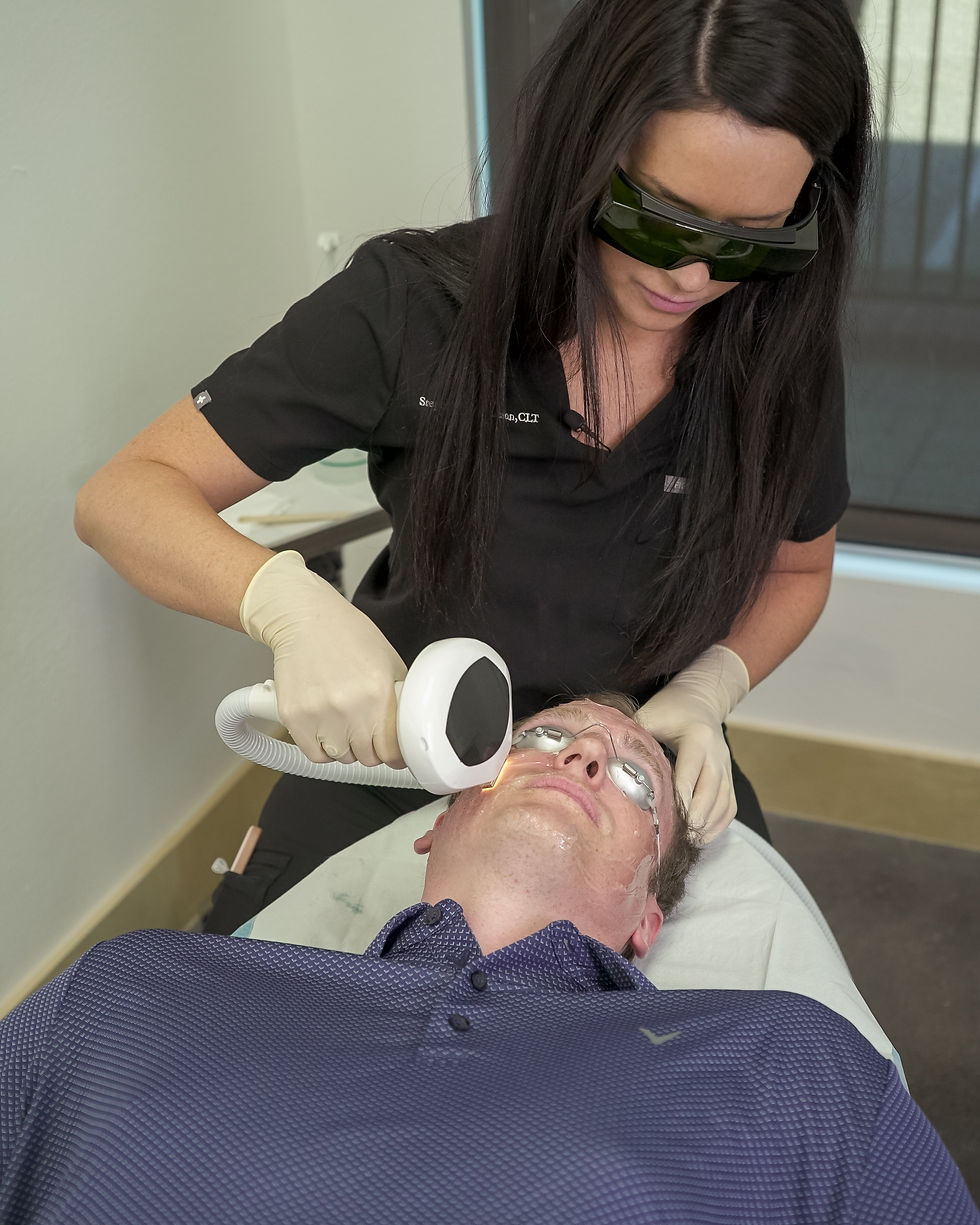
THE SHORT ANSWER, TREATMENT BY TREATMENT
The best time of year for laser treatment and IPL in North Texas is October through December, with treatment wrapping up by March. Midday UV in Dallas falls from Very High in September to Moderate by November and stays there through February. That low-UV stretch gives you room for the month of sun avoidance IPL Photofacial requires beforehand and the weeks of protection resurfaced skin needs afterward. Several treatments, including Morpheus8 and injectables, work in any month.
Our own schedule shows the same pattern. From 2023 through 2025, Hartwater performed nearly three times as many IPL treatments in January through March as in June through August, while Morpheus8 sessions held steady all year.
WHAT THE DALLAS UV CALENDAR LOOKS LIKE
The UV index measures the strength of the sun's burning ultraviolet radiation on a scale where 3 to 5 is Moderate, 6 to 7 is High, 8 to 10 is Very High, and 11 or more is Extreme.
The National Oceanic and Atmospheric Administration (NOAA) tracks the daily UV index for Dallas. In 2025, clear-sky midday readings sat around 3 in December and January, reached 8 by early April, and reached 10 to 12 from late May through August. They did not drop back below 6 until late October. NOAA's forecast put Dallas at Very High or Extreme on 123 days of the year.
For anyone planning a light-based treatment, that calendar sets the season. Spring arrives early in North Texas, and the summer UV plateau is long. Patio season, lake weekends, and outdoor sports fill both ends of it.
WHAT OUR OWN BOOKING DATA SHOWS
We looked at three full years of completed IPL and Morpheus8 appointments in our scheduling system, January 2023 through December 2025, and measured how each treatment's work is spread across the calendar.
IPL: January through March accounted for 33% of the year's IPL treatments. June through August accounted for 12%. October through March, the low-UV half of the year, accounted for 63%. Our busiest IPL months, December and January, each ran more than three times our slowest, August.
Morpheus8: spread almost evenly. January through March accounted for 26% of the year's sessions and June through August for 24%.
Patients and providers schedule IPL around the sun because the treatment depends on it. Morpheus8 does not, so its calendar stays flat. The table below lines up both treatments against the Dallas UV calendar.
*Data note: each month's share of completed IPL and Morpheus8 appointments at Hartwater Aesthetics, January 2023 through December 2025 combined. UV ranges are read from NOAA Climate Prediction Center daily UV index records for Dallas, 2025.
WHY IPL IS THE MOST SEASON-SENSITIVE TREATMENT
IPL (intense pulsed light) delivers a broad spectrum of light that is absorbed by pigment. That is how it lifts brown spots and sun damage, and it is also why a tan changes the treatment. Light energy cannot tell the difference between a sun spot and a recent tan. Treating tanned skin raises the risk of burns, blistering, and lasting pigment changes.
For that reason, Hartwater requires one month of sun avoidance before IPL, and patients with recent sun exposure are rescheduled until their skin returns to its baseline tone.
Now add up the full commitment. A standard IPL series is three sessions spaced about four weeks apart. With the month of avoidance before the first session and careful protection between sessions, you are looking at roughly four months of disciplined sun behavior. Starting in October or November puts those four months in the lowest-UV stretch of the year. Starting in April puts them squarely in the brightest.
IPL also works best on lighter skin tones (Fitzpatrick types I through III), where the pigment in the skin itself does not compete with the pigment being treated. For deeper skin tones and for melasma, we use a different tool, covered below.
After each session, treated spots darken for a day or two and then flake away over the following week. Many patients add dermaplaning during that window to clear the flaking skin faster.
HOW LASER RESURFACING FITS THE CALENDAR
Hartwater's [Alma Hybrid](https://www.hartwateraesthetics.com/laser-skin-resurfacing) laser combines two wavelengths: a 1570 nanometer non-ablative wavelength and a 10,600 nanometer CO2 wavelength. We use it in three ways, and each one has a different relationship with the seasons.
PIXEL LASER
The Pixel laser uses the 1570 nanometer wavelength alone. It treats pigment and fine texture without breaking the skin's surface, and most patients go back to normal activities the same day. Because it leaves the surface intact, the Pixel laser is the most forgiving of the three in a sunny month. Daily sunscreen is still non-negotiable.
HYBRID ADVANCED
Hybrid Advanced blends both wavelengths for deeper texture and tone work. Expect a few days of redness and swelling after each session. Fall through early spring is the comfortable window.
HYBRID CO2
Hybrid CO2 is the most intensive treatment on the platform, with about two weeks of significant recovery. Freshly resurfaced skin is more vulnerable to UV than it was before treatment, and the weeks after a CO2 session are when sun exposure does the most harm. Many patients plan Hybrid CO2 between Thanksgiving and early February, when the sun is weakest and a holiday break can absorb the recovery time.
TREATMENTS THAT WORK IN ANY SEASON
Some of the most effective treatments we offer are not tied to the calendar.
Morpheus8 uses radiofrequency energy delivered through microneedles to remodel collagen. Radiofrequency does not target pigment the way IPL light does, which is why our Morpheus8 schedule barely changes from January to August. Sun protection after treatment still matters.
Forma delivers non-invasive radiofrequency heating with no downtime and is a common summer choice.
Injectables such as Dysport, Botox, fillers, and Sculptra have no seasonal limits.
Medical-grade skin care is a daily, year-round foundation, and summer is when it matters most.
Patients who want brighter, more even skin before summer often pair a fall or winter IPL or laser series with a spring and summer plan built on Morpheus8, injectables, and a strong home regimen.
THE BEST TIME OF YEAR FOR LASER TREATMENT AND IPL: A NORTH TEXAS PLANNING CALENDAR
WHERE THIS FITS IN THE THREE PILLARS OF FACIAL AGING
IPL and laser resurfacing address the first of Hartwater's Three Pillars of Facial Aging: skin quality, meaning the tone, texture, and surface health of the skin. Sun damage is the biggest driver of declining skin quality, and it accumulates over years of Texas summers.
Skin quality is one of three separate processes. Loosening skin (laxity) and lost facial volume each need their own tools. That is why a winter IPL series often sits inside a longer plan that includes Morpheus8 for firmness or Sculptra for volume, sequenced across the year.
WHAT IT COSTS AT HARTWATER
We publish our pricing. IPL and most laser treatments are sold as three-session packages because a series produces the most complete result.
IPL Photofacial (3 sessions): Full Face $1,000, Full Face and Neck $1,500, Full Face, Neck and Chest $2,400
Pixel Laser (3 sessions): Full Face $1,650, Full Face and Neck $2,000
Hybrid Advanced (3 sessions): Full Face $3,200, Full Face and Neck $3,500
Hybrid CO2 (single session): Full Face $3,500, Full Face and Neck $4,000
Dermaplaning add-on during the post-IPL flaking window: $75
Full pricing for every treatment area is on our IPL and laser resurfacing pages.
FREQUENTLY ASKED QUESTIONS
Can I get IPL in the summer in Texas?
Sometimes, but it is rarely the best plan. IPL requires a month of sun avoidance before treatment and careful protection between sessions. That is hard to manage in a North Texas summer, with UV at Very High or Extreme for months. Any recent tan also means rescheduling. Most of our IPL patients start in the fall or winter.
How long should I avoid the sun before IPL?
At Hartwater, one month. If your skin is tanned or recently sun-exposed at your appointment, we will reschedule until it returns to its normal tone, because treating tanned skin with IPL can cause burns and pigment changes.
Is fall or winter better for laser resurfacing?
Both work well in North Texas. For Hybrid CO2, the deepest option, late fall through early February is ideal because the sun is weakest during the two-week recovery. Pixel Peel is far more flexible and can be done most of the year with strict sun protection.
Can I get Morpheus8 in the summer?
Yes. Morpheus8 uses radiofrequency energy, which does not target pigment the way IPL light does. Our appointment records show steady Morpheus8 scheduling in every month. Wear sunscreen while the treated skin heals.
Is IPL safe for melasma or darker skin tones?
We do not use IPL for melasma, because it can worsen the condition. IPL also carries a higher risk of pigment problems on deeper skin tones. Pixel Peel is our preferred alternative for both.
SCHEDULE A CONSULTATION
The best treatment plan starts with a skin assessment, and fall is the right time to have one. Hartwater Aesthetics is located at 7200 West University Drive, Suite 110, in McKinney, and serves patients from Frisco, Allen, Prosper, Plano, Celina, and across Collin County. Request a consultation or call (469) 757-7870.
SOURCES
NOAA Climate Prediction Center, Daily UV Index, Dallas, TX, 2025
American Academy of Dermatology, Melasma: Diagnosis and Treatment
University of Utah Health, What Is IPL and How Does It Beautify Skin?
Hartwater Aesthetics appointment records, January 2023 through December 2025 (aggregate counts)